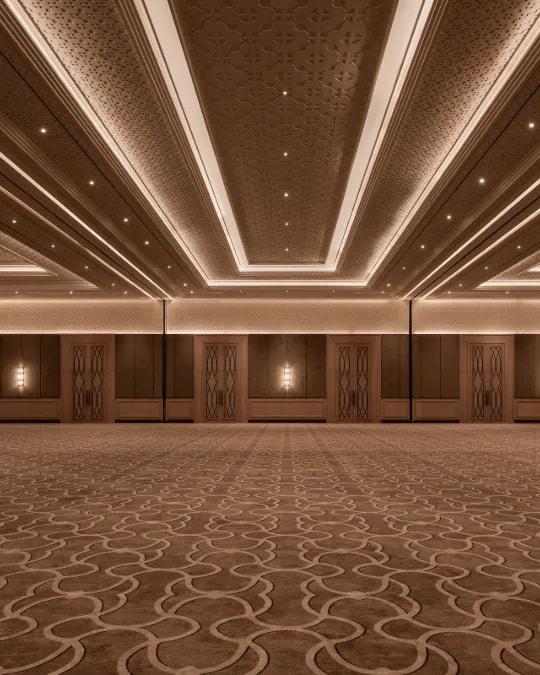
Short answer
Most buildings in Egypt use three types of suspended ceiling. Gypsum board ceilings give a smooth, jointless surface that can step, curve and hide lighting, so they go wherever the ceiling is part of the design. Tile ceilings on a metal grid lift out by hand, so they go where services above need regular access. Metal strip ceilings do not absorb moisture, so they go in wet, humid and semi-open areas. Cornices finish the edge of a ceiling, and fire-rated systems are a performance class that applies to walls and, sometimes, ceilings.
FUTURE supplies and installs all three ceiling types, plus cornices and fire-rated partitions, and has used them together on seven hotel and resort projects between 2019 and 2025 [1]. This guide explains each type and where it fits in hotels, residential schemes and commercial buildings.
What are the main types of suspended ceiling?
All suspended ceilings hang from the structural slab on a metal frame and leave a void above for ducts, pipes and cables. What changes is the visible surface and how easily it opens.
- Gypsum board ceiling (جبس بورد): gypsum boards screwed to a light steel frame, with the joints taped and finished so the ceiling reads as one painted surface. It can form steps, curves, coves for indirect light, bulkheads and curtain pelmets.
- Tile grid ceiling (بلاطات): a visible metal grid, usually in 600 × 600 mm or 600 × 1200 mm modules, with gypsum or other tiles laid into it. Any tile lifts out.
- Metal strip ceiling (شرائح، لينير): long aluminum or steel strips clipped onto carriers, factory-finished and unaffected by moisture.
Other types exist, such as timber, glass, stretch membrane and glass-reinforced gypsum ceilings. They are outside FUTURE's scope, so this guide covers them only by name.
How do the ceiling types compare?
| Type | Surface | Access to services | Moisture | Design freedom | Typical spaces |
|---|---|---|---|---|---|
| Gypsum board | Jointless, painted | Through planned access panels | Standard board for dry rooms; moisture-resistant board for wet rooms | High: steps, curves, coves | Guest rooms, apartments, lobbies, ballrooms, restaurants |
| Tile grid | Modular, visible grid | Any tile lifts out | Moisture-resistant or vinyl-faced tiles in humid areas | Low | Offices, back-of-house, service corridors, basements |
| Metal strip | Linear, factory-finished | Strips unclip | Unaffected; aluminum does not rust | Medium: linear patterns | Bathrooms, spas, terraces, coastal walkways, food courts |
Which ceiling type suits a hotel?
A hotel usually needs all three. Gypsum board carries the guest-facing spaces: rooms, suites, corridors, lobbies and the ballroom. Tiles cover back-of-house areas and offices where maintenance teams work above the ceiling. Metal strips go where water, steam or outside air would mark a painted ceiling, which on Red Sea and North Coast resorts includes many bathrooms, spa zones and terraces.
At Casa Del Mar Beach Hotel in Hurghada, FUTURE used all three systems across rooms, restaurants, a gym, meeting rooms, offices and a food court. At Jaz Elite Asteria in Sahl Hasheesh, gypsum board, aluminum strips and gypsum tiles went into the same package. For a room-by-room split, see how to choose hotel ceilings.
Which ceiling type suits a residential compound or villa?
Gypsum board is the usual choice for apartments, villas and townhouses, because owners expect a smooth ceiling with coves, bulkheads and curtain pelmets. Bathrooms and kitchens take moisture-resistant board. Tiles suit basements, service areas and management offices. Metal strips suit covered outdoor spaces and showers open to the ceiling. FUTURE built the villa ceilings at Sakhra Resort in Almaza Bay as part of a 2024 to 2025 package.
Which ceiling type suits offices, malls and mixed-use buildings?
Offices lean on tiles, because services above the ceiling change with every tenant fit-out. Boardrooms, receptions and mall public areas use gypsum board for the finished look. Food courts often mix a gypsum feature ceiling with metal strips or washable tiles near the counters. FUTURE's commercial-type work sits inside its hotel projects: a mall, a casino and meeting rooms at Giza Palace Hotel & Spa, and offices and a food court at Casa Del Mar.
Where do cornices and fire-rated systems fit?
Cornices are not a ceiling type. They are decorative profiles along the junction between wall and ceiling, and they belong in the same package as the ceiling because their line depends on the ceiling level. FUTURE installed Corniches cornices at Giza Palace and Corniches rustic finishes at Steigenberger Ras Soma.
Fire-rated is a performance class. In most buildings the fire-rated elements are partitions that run from slab to slab through the ceiling void. Where the fire strategy calls for a rated ceiling, it must be a tested gypsum system built exactly as tested. See fire-rated gypsum partitions explained.
How do you choose the right type for each space?
Ask five questions for every room:
- Is the ceiling part of the design? If yes, gypsum board.
- Will people need to reach services above it often? If yes, tiles, or gypsum with planned access panels.
- Does the ceiling get wet, or does outside air reach it? If yes, metal strips or moisture-resistant products.
- Does the fire strategy require a rated ceiling here? If yes, a tested gypsum system.
- Does a cornice or feature edge finish the room? If yes, keep it in the ceiling package.
Frequently asked questions
A false ceiling and a suspended ceiling are the same thing: a second ceiling hung below the structural slab. In Egypt it is also called سقف معلق or سقف ساقط.
The drop depends on what runs in the void above, mainly ducts, light fittings and sprinkler pipes. The shop drawings set it room by room once the MEP layouts are known.
Different systems can meet in one room using trims and shadow gaps, for example a gypsum perimeter with a tile centre. The junction is drawn on the shop drawings so the two systems finish at the same level.
Tile ceilings are the easiest to maintain, because any tile lifts out by hand. Metal strips come next. Gypsum board relies on access panels, so plan them before the ceiling is closed.
Sources
- FUTURE project records: seven hotel and resort ceiling packages, 2019 to 2025
- Manufacturer data for gypsum boards, ceiling tiles and linear metal ceilings, consulted November 2026